
How Many Microneedling Treatments Do You Need to See Results?
Table of Contents
- 1. Why the Number of Treatments Can Vary
- 2. RF Microneedling Sessions: What You Should Know
- 3. How an RF Microneedling Treatment Plan Is Determined
- 4. When Can You Start Seeing RF Microneedling Results?
- 5. Why Collagen Remodeling Takes Time
- 6. What Can Affect the Number of Treatments You Need?
- 7. How Are Treatments Spaced Apart?
- 8. What Should You Expect Between Treatment Sessions?
- 9. FAQ
- 10. Key Takeaways
- 11. Understanding Your Next Step
- 12. Disclaimer
- 13. References
If you are considering RF Microneedling Sessions, one of your biggest questions may be how many treatments it takes before you can actually see a difference. There is no single number that applies to everyone. Your skin concerns, treatment goals, starting skin condition, and individual response can all influence your treatment plan.
Results also tend to develop gradually because the skin’s response continues after an appointment. If you want more context on this process, understanding how treatments can support your skin’s natural collagen response can help explain why changes may continue over time.
Here is what you need to know about treatment frequency, expected timelines, collagen remodeling, and the factors that may influence how your treatment series is planned.
1. Why the Number of Treatments Can Vary
You might be wondering why a provider cannot simply tell every patient to complete the same number of treatments. The reason is that skin does not respond according to a universal schedule.
Your starting point matters. Someone interested in improving mild skin texture concerns may have different treatment goals from someone seeking improvement in the appearance of acne scars or more noticeable textural irregularities.
Your provider also needs to consider your skin, health history, areas being treated, treatment goals, and whether the procedure is appropriate for you in the first place.
This is why online treatment numbers should be viewed as general information rather than a prescription for your skin.
For example, one person may be focused on overall skin rejuvenation, while another may have a specific concern they hope to address. Even if both receive the same general type of procedure, their treatment plans do not necessarily need to look identical.
The important point is that the number of treatments should be based on an individualized assessment rather than a universal formula.
2. RF Microneedling Sessions: What You Should Know
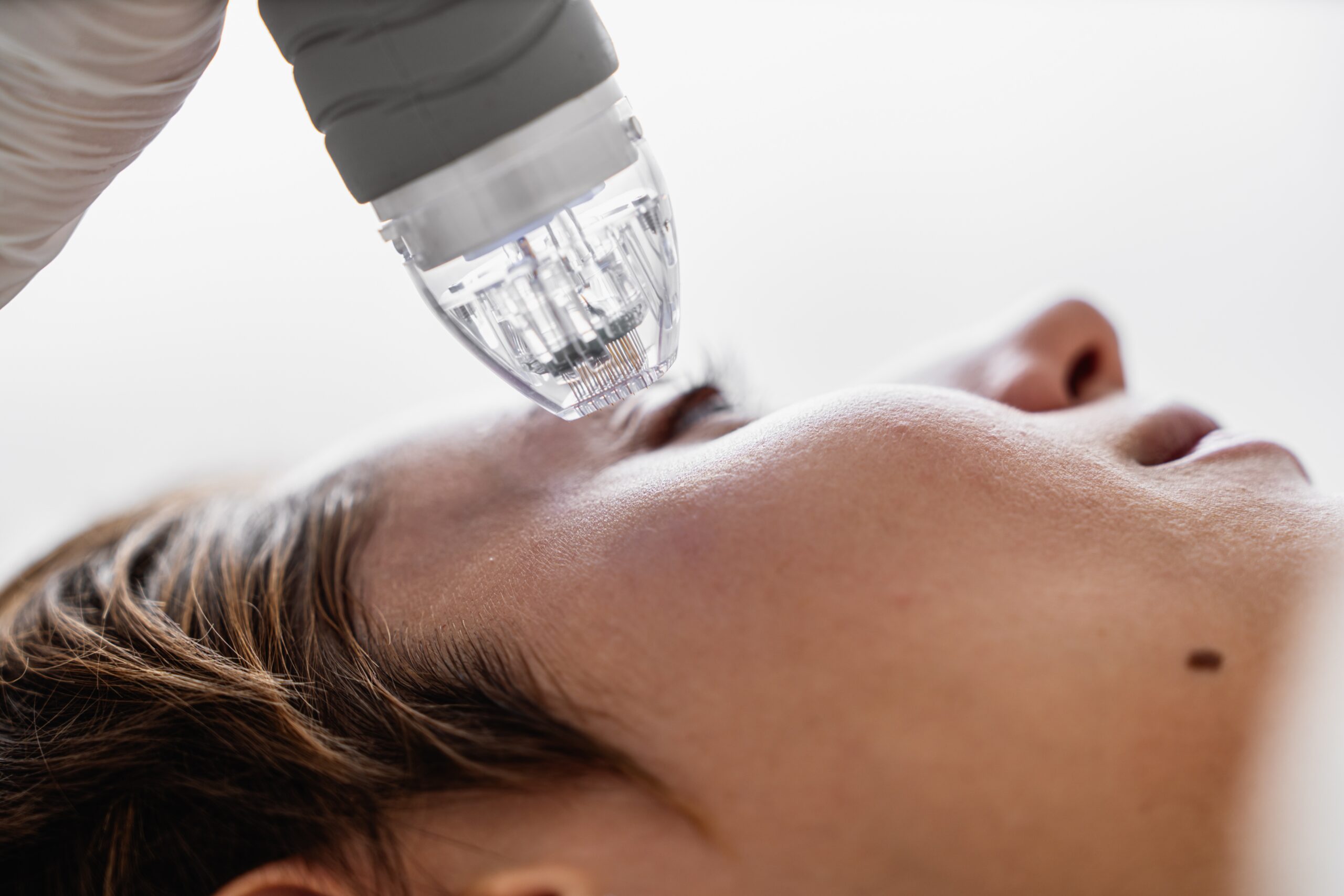
Radiofrequency microneedling combines very small needles with radiofrequency energy delivered into targeted layers of the skin. The controlled treatment is intended to stimulate a healing response that includes new collagen production.
According to Cleveland Clinic, two to four treatments are typically recommended for best results. Cleveland Clinic also explains that the number of treatments a person receives depends on their consultation and treatment plan.
That distinction is important.
Two to four treatments should not be interpreted as a guarantee or a rule that applies to every person. It is a general clinical reference point from a reputable medical organization.
Your individual treatment plan may be different.
A provider can evaluate how your skin responds and determine whether additional treatment is appropriate instead of deciding the entire process solely from a general number found online.
3. How an RF Microneedling Treatment Plan Is Determined
A thoughtful RF microneedling treatment plan begins with evaluation, not with choosing an arbitrary number of appointments.
Your provider may ask what changes you would like to see, examine the areas you want treated, discuss your medical history, and determine whether the procedure is appropriate for your circumstances.
Your goals are particularly important.
Someone seeking a subtle improvement in overall skin quality may approach treatment differently from someone concerned about visible textural irregularities. Your provider may also consider how your skin responds after an initial treatment before determining what should happen next.
Treatment planning should therefore remain flexible.
If you are exploring whether this type of procedure may fit your goals, reading more about how an individualized approach to RF microneedling may be planned can provide additional context without replacing a professional evaluation.
A treatment series is better understood as a personalized process than as a fixed package of appointments.
4. When Can You Start Seeing RF Microneedling Results?
It is natural to look closely at your skin after a procedure and wonder whether it worked. With radiofrequency microneedling, however, evaluating treatment results too early can give you an incomplete picture.
Cleveland Clinic explains that best results are typically achieved about three to six months after the first treatment because collagen production continues during that period.
This does not mean that every person will notice the same changes at the same point in time. It also does not mean that your skin will remain unchanged until several months have passed.
Instead, it highlights an important feature of this type of treatment: some of the biological processes associated with the procedure continue after you leave the treatment room.
That is why comparing your appearance immediately after an appointment with someone else’s final results can be misleading.
Give your skin time to respond, and follow the evaluation timeline recommended by the healthcare professional overseeing your treatment.
5. Why Collagen Remodeling Takes Time
Collagen is a structural protein that helps support your skin. Treatments designed to trigger a controlled healing response rely partly on biological processes that do not happen instantly.
Think of it less like applying makeup, where you can immediately see the finished effect, and more like starting a gradual process within your skin.
Following treatment, the skin begins a healing response. Collagen production and remodeling can continue as that process progresses. This helps explain why evaluating the outcome of a treatment series requires patience.
It also explains why more treatment is not necessarily better simply because you want faster results.
Your skin needs time between procedures, and your provider needs an opportunity to evaluate how you are responding.
The goal should not be to complete as many treatments as possible. The goal is to follow an appropriate treatment plan while allowing enough time to evaluate your response.
This is one reason treatment timelines should be discussed during your consultation rather than determined by an online calendar.
6. What Can Affect the Number of Treatments You Need?
There are several reasons one person’s treatment series may look different from another person’s.
Your starting skin condition is one consideration. The severity and type of skin concerns you want to address can also influence planning. Your treatment goals matter as well because a subtle improvement and a more substantial correction are not the same objective.
Other considerations may include the treatment area, your health history, the provider’s assessment, the device being used, treatment settings, and how your skin responds over time.
This makes before-and-after comparisons on social media particularly limited. You may see someone report a certain result after a certain number of appointments, but you usually do not know all the variables involved in that person’s care.
Instead of asking, “How many treatments did that person need?” a more useful question is, “What treatment plan makes sense for my skin and goals?”
Safety also belongs in this conversation. The U.S. Food and Drug Administration (FDA) describes radiofrequency microneedling as a medical procedure and recommends discussing its benefits and risks with a healthcare provider. The agency also recommends choosing a licensed healthcare provider who has training and experience using these devices.
Treatment decisions should therefore consider both your cosmetic goals and whether the procedure can be performed appropriately for you.
7. How Are Treatments Spaced Apart?
Knowing how many treatments may be recommended is only part of the picture. The timing between appointments matters too.
It can be tempting to think that scheduling treatments closer together will produce faster changes. That is not an assumption you should make on your own.
Radiofrequency microneedling creates a controlled response in the skin, and the skin needs time to move through its healing and remodeling processes. Your provider should determine the appropriate treatment frequency based on the procedure, device, treatment settings, area treated, and your individual response.
This also means that a treatment calendar you find online should not automatically become your personal schedule.
Your provider may want to evaluate your skin before proceeding with another appointment. That evaluation can help determine whether your recovery is progressing as expected and whether the treatment plan should remain the same.
Spacing is part of the treatment strategy, not simply empty time between appointments.
If you have a major event, vacation, or other deadline in mind, mention it during your consultation so your provider can explain what timeline may be realistic.
8. What Should You Expect Between Treatment Sessions?
The time between appointments is not simply a waiting period. Your skin is recovering, and you should follow the individualized instructions you receive after each procedure.
Temporary changes can occur following treatment. What you experience and how long those effects last can vary, so your provider’s instructions should take priority over generalized advice from social media or another person’s experience.
This is also a good time to observe your skin without constantly judging the final result.
If you want to prepare for the recovery period, learning how to care for your skin following RF microneedling can give you additional educational guidance about what happens after treatment.
Avoid trying to speed up your results by changing your treatment schedule yourself or adding procedures without discussing them with your healthcare provider.
Your provider may evaluate your progress at different stages of the treatment series. These check-ins can help determine whether your skin is responding as expected and whether any part of the plan needs to change.
9. FAQ
How many microneedling treatments do most people need?
There is no universal number that is appropriate for everyone. Cleveland Clinic notes that two to four radiofrequency microneedling treatments are typically recommended for best results, but your actual treatment plan depends on your consultation, skin concerns, goals, and response. Treat general numbers as educational guidance rather than a personal treatment prescription.
Can you see results after one treatment?
You may notice changes as your skin recovers, but it is important not to assume that an early change represents the final outcome. Collagen production and remodeling continue after treatment, which means improvements can develop gradually. Your provider can explain when it makes sense to evaluate your progress.
How long should you wait between treatments?
The appropriate interval should be determined by the healthcare professional providing your treatment. Treatment spacing can depend on factors such as the device, treatment area, settings, your skin response, and the overall plan. Avoid creating your own schedule based solely on another patient’s experience.
Do more treatments always produce better results?
No. More treatments should not automatically be considered better. The purpose of a treatment plan is to determine an appropriate approach for your individual skin and goals. Additional procedures should be considered based on professional assessment rather than the assumption that increasing the number will always improve the outcome.
Why do results continue to change after treatment?
Radiofrequency microneedling is intended to stimulate a healing response that includes collagen production and remodeling. Those processes take time. As a result, the appearance of your skin may continue to evolve after the procedure rather than showing the complete result immediately.
Key Takeaways
- There is no single treatment number that applies to everyone.
- Cleveland Clinic notes that two to four treatments are typically recommended, but individual plans can differ.
- Your skin concerns, treatment goals, treatment area, health history, and response may influence your plan.
- Collagen production and remodeling continue after treatment, so results may develop gradually.
- More treatments do not automatically mean better or faster results.
- Treatment spacing should be determined by the healthcare professional overseeing your care.
- The FDA considers radiofrequency microneedling a medical procedure and recommends choosing an appropriately trained and experienced licensed healthcare provider.
- Your provider’s individualized recommendations should take priority over treatment schedules or experiences shared online.
The number of appointments matters, but the quality and appropriateness of your treatment plan matter more.
Understanding Your Next Step
Deciding how many treatments you may need starts with understanding that your skin, goals, and response are individual. General treatment ranges can give you useful context, but they cannot replace an evaluation or predict exactly how your skin will respond.
A thoughtful approach gives your skin time to recover and allows your progress to be evaluated before decisions about additional treatment are made.
If you are exploring whether this procedure fits your skin concerns and treatment goals, you can learn more about Microneedling with RF and the role individualized treatment planning can play in the process.
Disclaimer
This article is intended for educational and informational purposes only. It is not medical advice, diagnosis, or a substitute for individualized evaluation or treatment from a qualified healthcare professional.
The appropriate number, timing, settings, and suitability of radiofrequency microneedling treatments can vary based on your health history, skin condition, treatment area, goals, device used, and individual response. General treatment ranges should not be interpreted as a personal recommendation or guarantee of results.
Radiofrequency microneedling can involve risks and potential complications. Discuss potential benefits, risks, alternatives, expected recovery, and treatment planning with an appropriately qualified healthcare professional before undergoing treatment. Seek medical attention if you develop severe, unusual, or rapidly worsening symptoms following a procedure.